
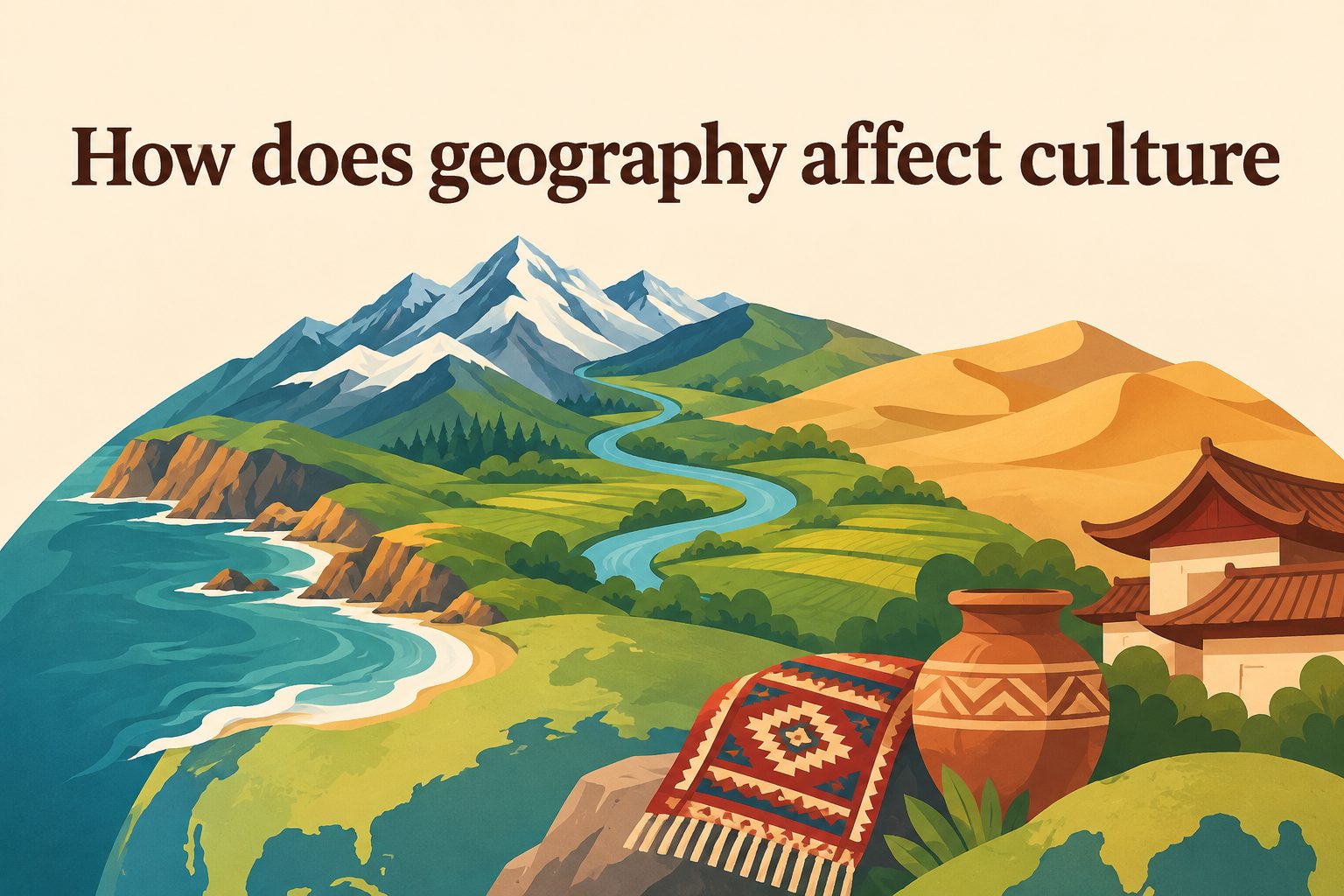
How does geography affect culture? The answer begins with the places where people live, travel, work, and find resources. Mountains, rivers, coastlines, climate, soil, and distance all shape daily choices over generations. Those choices can influence food, language, homes, clothing, celebrations, jobs, trade, and social values. Geography does not control people’s lives completely, because culture also changes through history, technology, migration, and creativity. Still, it creates important conditions that communities respond to in practical and meaningful ways. This article explains the connection between geography and culture, shows clear examples, highlights common misunderstandings, and offers useful ways to study cultural differences with care.
How Geography Shapes Culture
Geography affects culture by setting the physical conditions people adapt to every day.
1. Climate Influences Daily Life
Climate affects what people wear, when they work, and how they organize their homes. Communities in very cold places may value insulation, stored food, and warm shared spaces, while hot climates often encourage lighter clothing, shade, ventilation, and schedules that avoid intense midday heat.
2. Landforms Shape Settlement Patterns
Mountains, plains, islands, and deserts influence where people can build communities and how easily they connect with others. A remote valley may develop distinctive customs because contact is limited, while a fertile plain may support larger towns, markets, and more frequent cultural exchange.
3. Water Sources Support Communities
Rivers, lakes, rainfall, and coastlines strongly influence settlement and culture. Reliable water supports farming, transport, fishing, and trade. Many important cities grew beside rivers or seas because these locations created opportunities for communication, food production, and contact with different groups.
4. Natural Resources Guide Work
Available resources often shape traditional occupations and skills. Forest areas may develop woodworking traditions, coastal regions may depend on fishing and boat building, and mineral-rich places may support mining. These activities can influence local stories, family roles, tools, and community celebrations.
5. Distance Affects Cultural Exchange
Distance can slow the movement of people, goods, and ideas. Communities separated by mountains, deserts, or large bodies of water may preserve unique languages and customs. Places located along trade routes, however, often absorb outside influences and develop more mixed cultural traditions.
6. Risk Shapes Shared Practices
Environmental risks such as floods, droughts, storms, earthquakes, or harsh winters can create habits of planning and cooperation. Communities may build protective homes, store supplies, follow seasonal rituals, or develop strong mutual-help networks because survival depends on collective preparation and local knowledge.
Key Geographic Factors In Cultural Development
Several geographic conditions repeatedly influence how cultures develop and adapt over time.
- Climate: Temperature and rainfall affect clothing, housing, food choices, and work routines.
- Terrain: Mountains, valleys, plains, and islands influence travel, isolation, and settlement size.
- Water Access: Rivers and coastlines support farming, fishing, transport, and trade.
- Soil Quality: Fertile land can support agriculture, stable settlements, and population growth.
- Natural Resources: Timber, stone, metals, and wildlife can shape local crafts and occupations.
- Location: A place near trade routes may experience more migration, exchange, and cultural diversity.
Geography And Food Traditions
Food is one of the clearest ways to see how geography affects culture.
1. Local Crops Become Staple Foods
People often build meals around crops that grow well in their region. Rice became central in many wet farming areas, while wheat, maize, potatoes, millet, and cassava became important elsewhere. Over time, staple crops influence recipes, meal schedules, family traditions, and hospitality customs.
2. Coastal Areas Use Seafood
Communities near seas, lakes, and rivers often include fish, shellfish, seaweed, or freshwater species in everyday cooking. Fishing knowledge can become part of local identity, including seasonal rules, preservation methods, boat traditions, and meals prepared for festivals or family gatherings.
3. Dry Regions Value Preservation
In dry or seasonal environments, people may preserve food through drying, salting, fermenting, smoking, or storing it carefully. These methods reduce waste and protect food supplies during difficult periods. What began as a practical response can later become a valued culinary tradition.
4. Livestock Suit Local Environments
Different landscapes support different animals. Pastoral communities may rely on goats, sheep, cattle, camels, or yaks according to local conditions. Milk products, meat dishes, leatherwork, and herding customs often reflect the animals that can survive and provide steady resources.
5. Trade Adds New Ingredients
Geography also affects which foods arrive through trade. Port cities and crossroads often adopt spices, fruits, grains, and cooking techniques from distant places. Local cooks then adapt these influences, creating dishes that reflect both regional resources and wider cultural connections.
6. Seasons Shape Eating Habits
Seasonal weather changes what is available and when it is eaten. Harvest celebrations, winter storage meals, spring greens, and summer fruit traditions often grow from local agricultural cycles. These seasonal patterns connect food culture to the rhythm of the landscape.
Ways To Study Geography And Culture
These steps can help students, travelers, and researchers explore the relationship carefully.
- Observe The Environment: Notice climate, terrain, water access, vegetation, and natural resources.
- Identify Daily Adaptations: Look at housing, clothing, transport, work, and food practices.
- Learn Local History: Consider migration, trade, colonization, conflict, and environmental change.
- Compare Nearby Regions: Examine how small geographic differences can produce different traditions.
- Listen To Local Voices: Ask how residents explain their own customs and priorities.
- Avoid Simple Assumptions: Remember that geography influences culture but never explains everything.
- Track Change Over Time: Consider how technology and mobility alter older geographic patterns.
Examples Of Geography Affecting Culture
Real examples show that geography creates influences rather than fixed rules.
1. Mountain Communities And Independence
Mountain regions can be difficult to reach, especially before modern roads and communication. This relative isolation may help preserve local languages, music, farming methods, and customs. It can also encourage close cooperation, since neighbors often depend on one another during severe weather or emergencies.
2. Island Cultures And Maritime Skills
Island communities frequently develop strong knowledge of the sea, including navigation, fishing, boat building, and weather reading. Because imported goods may be limited or expensive, local people may also develop careful resource use, strong trade relationships, and distinct coastal food traditions.
3. River Valleys And Agriculture
River valleys often support fertile farmland and dependable water supplies. This can encourage settled agriculture, irrigation systems, and larger population centers. Rivers may also become routes for trade and travel, bringing new religious ideas, languages, crafts, and political relationships into the region.
4. Desert Regions And Mobility
Desert environments often require detailed knowledge of water, shade, animals, and seasonal movement. Some communities developed mobile lifestyles suited to scarce resources, while others built settlements around wells or oases. Hospitality and sharing can become especially important where travelers depend on local support.
5. Forest Regions And Material Culture
Forested areas can provide timber, game, edible plants, fibers, and shelter materials. These resources may shape building styles, tools, crafts, and stories about the natural world. Forest cultures are not identical, but access to woodland resources often leaves visible marks on everyday life.
6. Port Cities And Cultural Blending
Ports connect local communities with sailors, merchants, migrants, and visitors from many places. As a result, port cities often show blended languages, food traditions, religious practices, music, and architecture. Their cultures demonstrate how geographic access can make exchange a normal part of daily life.
Culture Is More Than Geography
Geography matters, but it works alongside many other forces.
History can change cultural patterns quickly. Wars, political borders, migration, and colonization may reshape languages, food systems, and identities even when the physical landscape stays the same.
Technology can reduce some geographic barriers. Roads, aviation, digital communication, refrigeration, and irrigation allow people to live and work in ways that were once difficult or impossible.
Human choices also matter. Communities decide which traditions to protect, adapt, share, or leave behind. Two groups living in similar environments can create very different cultures because their histories and values differ.
Culture is therefore best viewed as an ongoing conversation between people, place, memory, opportunity, and change. Geography provides conditions, but people give those conditions meaning.
How Geography Affects Language And Identity
Place can influence how communities communicate and describe themselves.
1. Isolation Can Preserve Languages
Remote valleys, islands, and mountain areas may have fewer outside contacts, allowing local languages or dialects to remain strong for longer periods. Geography alone does not preserve language, but reduced contact can make it easier for a community to maintain distinctive speech patterns.
2. Trade Routes Encourage Multilingualism
Communities along commercial routes often interact with travelers and merchants from different backgrounds. This can encourage multilingual skills, borrowed words, mixed dialects, and shared communication habits. Such linguistic exchange reflects the practical need to trade, negotiate, and build relationships across cultural boundaries.
3. Landscapes Shape Local Vocabulary
People usually develop detailed vocabulary for features that matter in their environment. Fishing communities may have many terms for tides and sea conditions, while farming communities may name soils, crops, and weather patterns precisely. Language often records generations of environmental knowledge.
4. Place Supports Belonging
People often connect identity to a homeland, neighborhood, coast, river, or mountain range. Shared attachment to a place can appear in songs, flags, stories, festivals, and family memories. These cultural expressions help communities explain where they come from and what they value.
5. Borders Create New Cultural Patterns
Political borders can divide communities that share a landscape or bring different groups into one state. Over time, borders may influence education, official languages, laws, and national identity. Yet people living near borders often maintain cross-border family, trade, and cultural connections.
6. Migration Creates Layered Identities
When people move between regions, they bring customs shaped by earlier places and adapt them to new surroundings. Migrant communities may combine old food, language, religion, and celebrations with local traditions. This creates identities that are connected to more than one geographic home.
Common Mistakes When Explaining Geography And Culture
A careful explanation avoids treating geography as destiny.
1. Treating People As Products Of Climate
It is inaccurate to claim that a climate automatically gives people certain personalities or abilities. Climate can influence routines and resources, but it does not determine intelligence, character, or cultural worth. Good explanations focus on adaptation, history, and human choice rather than stereotypes.
2. Ignoring Historical Events
Geography cannot fully explain a culture without history. Migration, empire, conflict, trade, religion, and political decisions may have enormous effects on local life. When discussing culture, connect physical conditions with the events and relationships that shaped how communities responded to them.
3. Assuming One Region Has One Culture
Most regions contain many communities with different languages, beliefs, incomes, and experiences. A country, coast, mountain range, or city is rarely culturally uniform. Avoid broad statements that erase local diversity, minority groups, or important differences between urban and rural communities.
4. Using Outdated Or Romantic Images
Culture changes constantly, and people are not frozen in the past. Traditional practices can remain meaningful while communities also use modern technology, travel widely, and create new forms of expression. Present cultures as living and changing rather than as museum displays.
5. Forgetting Power And Inequality
Access to land, water, transport, and safe housing is not shared equally. Geography can interact with wealth, discrimination, and government policy, creating unequal opportunities. A complete discussion should recognize that environmental challenges often affect vulnerable communities more severely than others.
6. Confusing Influence With Determination
The key idea is influence, not certainty. Similar environments can produce different cultural outcomes because people make different choices and experience different histories. Use phrases such as “can shape,” “may encourage,” and “often influences” instead of suggesting that geography guarantees one result.
Best Practices For Learning About Culture And Place
These habits lead to more respectful and accurate cultural learning.
1. Start With Curiosity
Ask how people use and experience their environment instead of assuming you already know the answer. Curiosity creates space for better questions about food, homes, work, celebrations, and travel. It also helps replace stereotypes with specific, human stories and observations.
2. Use More Than One Source
Combine maps, local histories, interviews, museum materials, academic research, and everyday observations when possible. Different sources reveal different parts of the relationship between geography and culture. Comparing them can prevent a single simplified explanation from becoming the whole story.
3. Notice Local Variation
Look for differences within a region, not only between countries. Coastal and inland towns, cities and villages, or neighboring valleys may have distinct experiences. Paying attention to variation makes cultural analysis more accurate and shows how flexible human adaptation can be.
4. Include Environmental Change
Climate change, drought, rising seas, and urban growth can alter cultural practices and livelihoods. When learning about place, consider how communities are adapting today. This adds a realistic perspective and recognizes that geography is not always stable or predictable over time.
5. Respect Community Knowledge
Local knowledge about weather, land, water, plants, and seasons often comes from long experience. Treat it seriously while recognizing that no community is a single voice. Listening respectfully helps explain why practices exist and how they continue to evolve.
6. Use Careful Language
Choose words that describe patterns without making absolute claims. Say that a landscape influenced traditions rather than caused every aspect of them. Careful language respects people’s agency and makes explanations more useful for readers who want a balanced view of culture.
Frequently Asked Questions
1. Does Geography Completely Determine Culture
No. Geography influences resources, travel, climate, and settlement, but it does not completely determine culture. History, migration, religion, politics, technology, and individual creativity also matter. People adapt to similar environments in different ways, so cultural outcomes are never automatic or identical.
2. Why Do Coastal Cultures Often Differ From Inland Cultures
Coastal communities often have easier access to fishing, shipping, trade, and contact with visitors from other regions. Inland communities may depend more on farming, grazing, or land-based transport. These different opportunities can influence food, jobs, language, architecture, and local traditions.
3. Can Geography Affect Clothing Styles
Yes. Temperature, rainfall, wind, sun exposure, and available materials can influence clothing choices. Warm climates may encourage light fabrics and loose designs, while cold regions may favor layers and insulation. Clothing also reflects fashion, identity, religion, trade, and personal preference.
4. How Does Geography Influence Religion
Geography can influence religious practices through seasonal cycles, sacred landscapes, travel routes, and local environmental needs. Mountains, rivers, forests, and deserts may hold spiritual meaning. However, religious beliefs also spread through history, migration, teaching, and political change, not geography alone.
5. Why Are Mountain Regions Often Culturally Distinct
Mountain terrain can make travel difficult and reduce frequent contact with outside communities. This may help preserve local languages, customs, and crafts. At the same time, mountain communities are not isolated from history; trade, migration, tourism, and technology continue to shape them.
6. Does Modern Technology Make Geography Less Important
Technology reduces some barriers by improving transport, communication, farming, and access to goods. Yet geography still matters because climate, natural hazards, water, land, and location affect daily life. Technology changes how people adapt to place rather than removing the importance of place entirely.
Conclusion
Geography affects culture by influencing the resources people use, the risks they face, the work they do, and the connections they make. Climate, terrain, water, trade routes, and distance can shape food, language, housing, traditions, and identity over generations.
At the same time, geography is only one part of the story. Culture also grows through history, movement, technology, values, and human choices. Looking at both place and people gives a fuller, more respectful explanation of why cultures develop in such varied and meaningful ways.
Discussion