
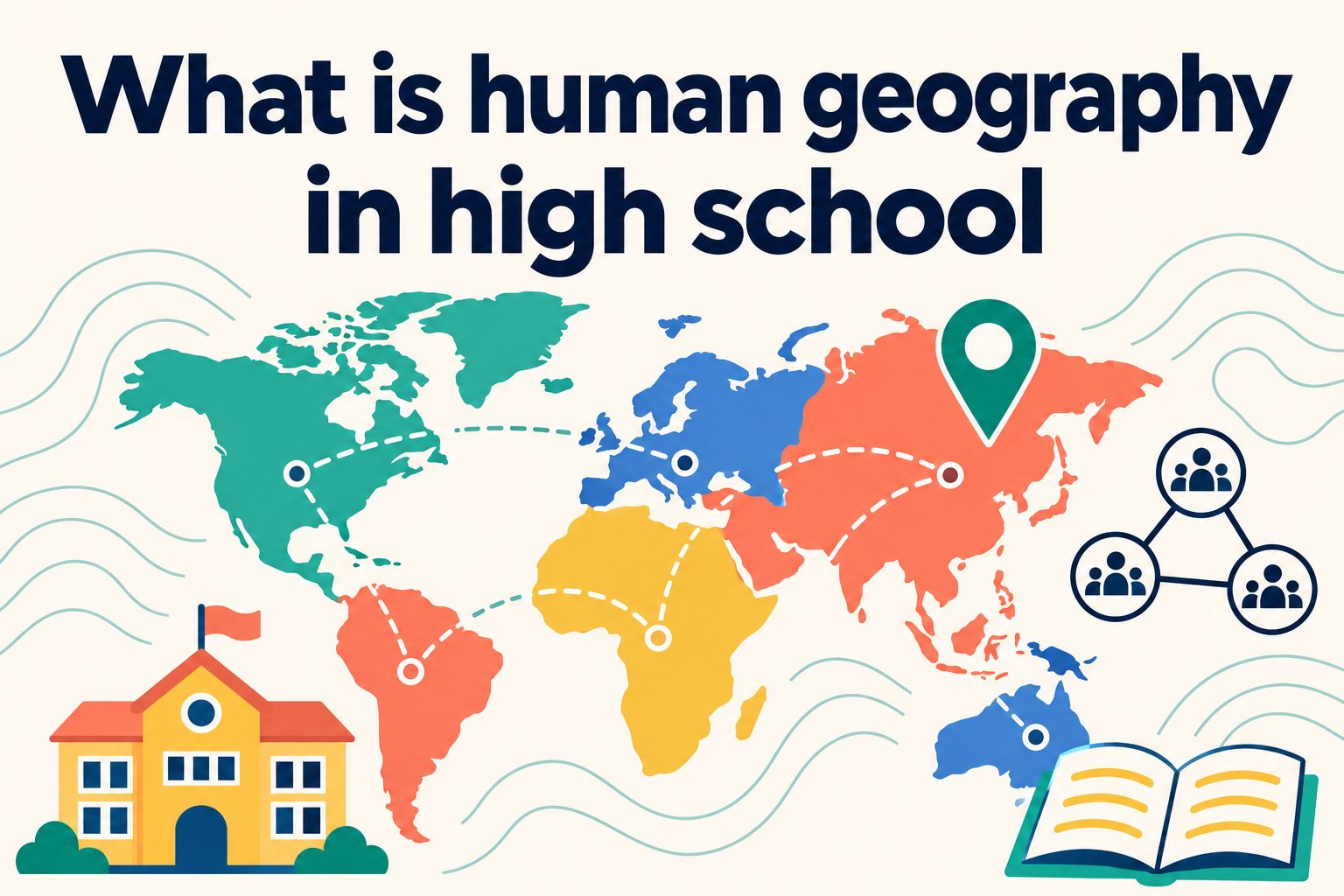
Human geography in high school is the study of people, places, cultures, economies, and the ways humans shape the world around them. Rather than focusing mainly on landforms, weather, or rocks, it asks questions about why people live where they do, how communities change, and how ideas and goods move between regions. Students learn to look beyond maps as simple pictures and use them to explain real human patterns. This subject can feel broad at first, but that is part of its value: it connects current events, history, economics, culture, and environmental issues. In this article, you will learn what the course covers, why it matters, how students use geographic thinking, common topics and examples, useful study habits, and answers to frequent questions.
What Human Geography Means
Human geography examines the relationship between people and places. It studies how populations are distributed, why cities grow, how cultures spread, and how governments and businesses influence daily life. The subject also considers how people use natural resources and respond to environmental challenges.
In high school, human geography is often taught as a year-long social studies course or as part of an advanced geography program. Students use maps, graphs, photographs, case studies, and current events to investigate patterns. The goal is not simply to memorize locations. It is to explain why patterns exist and what their effects may be.
Human geography is different from physical geography, although the two areas often connect. Physical geography focuses on natural features such as climate, rivers, mountains, and ecosystems. Human geography focuses on human activity, including settlement, migration, farming, trade, language, religion, and political borders.
Why Human Geography Matters In High School
This subject gives students a practical way to make sense of a connected world. News stories about immigration, housing costs, drought, international trade, public health, or elections often have a geographic side. Human geography helps students see the larger patterns behind those stories.
It also encourages respectful curiosity. When students learn about different cultures and communities, they can move beyond stereotypes and recognize that people make choices within specific historical, economic, political, and environmental conditions.
Human geography builds skills that are useful far beyond the classroom. Students learn to compare evidence, interpret data, identify cause and effect, support an argument, and consider more than one viewpoint. These skills can help in college, work, civic life, and everyday decision-making.
Major Topics In Human Geography
Population is a major topic. Students explore where people live, how population changes over time, and why some places have rapidly growing or aging populations. They may examine birth rates, death rates, life expectancy, and population density.
Migration is another central area. Students consider why people move voluntarily or are forced to leave their homes. Common factors include jobs, education, family, conflict, discrimination, environmental change, and natural disasters.
Culture is also important. Human geography looks at language, religion, food, music, clothing, traditions, and beliefs. Students learn how cultural traits spread through migration, trade, technology, colonization, and popular media.
Cities and urbanization are frequently studied. Students analyze why cities form, how neighborhoods develop, and how transportation, housing, jobs, and public services affect urban life. They may compare large global cities with smaller towns and suburbs.
Economic geography explores how goods and services are produced, exchanged, and consumed. Topics can include agriculture, manufacturing, global supply chains, tourism, trade, and the uneven distribution of wealth.
Political geography focuses on borders, states, nations, territorial disputes, voting patterns, and international organizations. It helps students see how power and identity influence maps and political decisions.
How Students Learn Human Geography
Human geography classes use a variety of materials because the subject involves both facts and interpretation. A map may show where people live, but students must ask why a pattern appears and what it means.
Students often work with population pyramids, migration maps, climate data, census information, satellite images, political maps, and news reports. They may compare several sources to see whether each one supports the same conclusion.
Case studies are especially common. A teacher may ask students to explore one city, country, migration route, farming region, or cultural practice in detail. This approach helps students connect broad concepts to real places and people.
Class discussions are also valuable. Many human geography topics involve difficult questions with more than one reasonable viewpoint. Students are expected to use evidence, listen carefully, and explain their reasoning rather than simply give personal opinions.
Examples Of Human Geography Questions
A human geography question might ask why people cluster near coasts, rivers, and transportation routes. Students could explain that these locations often provide access to water, trade, jobs, and fertile land.
Another question could examine why a city is growing quickly. Students might investigate employment opportunities, rural-to-urban migration, improved transportation, government policy, or international investment.
A class may also study the spread of a language or religion. Students would consider migration, trade, conquest, education, communication technology, and political power as possible reasons for that spread.
Food production offers another clear example. Students may compare small family farms with large commercial farms, then consider how climate, land ownership, markets, technology, labor, and consumer demand shape agricultural choices.
A lesson on political geography could ask why borders sometimes lead to conflict. Students may explore colonial history, ethnic identity, access to resources, security concerns, and differing ideas about national belonging.
Human Geography And Everyday Life
Human geography is not limited to distant countries or famous cities. It can help students notice patterns in their own communities. For example, they may ask why certain stores, schools, parks, or bus routes are located in particular neighborhoods.
Housing is a useful local example. Home prices and rental costs can be affected by transportation access, job centers, school districts, public investment, zoning rules, and neighborhood change. Human geography gives students language for discussing these forces.
Transportation is another familiar topic. A new highway, train line, bike lane, or bus route can change commuting patterns, business activity, and access to services. Geographic thinking helps students consider who benefits and who may be left out.
Students can also use human geography to explore local food systems. They may look at where grocery stores are located, how food reaches the community, and why some neighborhoods have different levels of access to fresh food.
Benefits Of Taking Human Geography
Human geography can make other subjects easier to connect. History becomes clearer when students see how location, migration, resources, and trade influenced events. Economics becomes more concrete when students study real markets, workers, and industries.
The course can improve map literacy. Students learn how to read scales, symbols, patterns, projections, and spatial relationships. They also learn that maps can highlight certain information while leaving out other details, so maps should be interpreted thoughtfully.
It can strengthen writing and speaking skills. Students often explain geographic patterns in short responses, essays, presentations, or debates. Good answers require clear claims, accurate vocabulary, and evidence from maps, data, and examples.
The subject can also support career exploration. Fields such as urban planning, public health, business, education, environmental work, government, transportation, journalism, tourism, and international relations all use geographic ideas in some way.
Common Human Geography Concepts
Place refers to the characteristics that make a location distinct. These characteristics may be physical, such as climate, or human, such as language, architecture, and local traditions.
Region is an area grouped by shared features. A region can be based on climate, culture, politics, economics, or another pattern. Regions are useful because they help people compare areas, but their boundaries are not always exact.
Movement describes the flow of people, goods, information, and ideas. Migration, trade, social media, tourism, and transportation systems are all examples of movement.
Human-environment interaction examines how people depend on, adapt to, and change their environment. Building dams, farming dry land, protecting forests, and preparing for floods are examples of this relationship.
Scale matters in human geography. A local issue, such as traffic in one neighborhood, may connect to regional, national, or global systems. Students learn to consider whether a pattern looks different at different scales.
Common Mistakes Students Should Avoid
One common mistake is treating human geography as a memorization course. Knowing locations and definitions is useful, but strong geography answers explain relationships. Students should practice asking why a pattern exists, not only where it appears.
Another mistake is assuming that one factor explains everything. Migration, poverty, urban growth, and cultural change usually have several causes. Better answers recognize how economic, political, cultural, historical, and environmental factors can work together.
Students should also avoid using broad stereotypes about countries or communities. Human geography emphasizes variation within places. No country, city, religion, or cultural group can be accurately described by one simple statement.
Ignoring data limitations can lead to weak conclusions. Maps and graphs are helpful, but they may be outdated, incomplete, or based on different definitions. Students should check what the data measures and whose experiences may not be fully represented.
Finally, students should avoid writing answers that list facts without making a clear argument. A strong response uses evidence to support a point. It connects the example directly to the geographic concept being discussed.
Best Practices For Studying Human Geography
Start by learning key vocabulary, but connect each term to a real example. For instance, do not only memorize the definition of urbanization. Think about a city that has grown quickly and the changes that growth created.
Use maps actively. Before reading a map key or caption, look for patterns. Ask where clusters appear, where gaps exist, and whether the pattern follows coastlines, borders, rivers, roads, or major cities.
Practice explaining cause and effect. A helpful sentence pattern is: a geographic factor leads to a change, which produces a result. This structure can make written responses clearer and more analytical.
Compare places carefully. When comparing two countries or cities, identify both similarities and differences. Then explain the factors that may account for those differences instead of assuming that one place is simply more successful than another.
Review current events through a geographic lens. A news story about a drought, election, migration route, factory, disease outbreak, or housing shortage can become a quick practice activity. Ask which human geography concepts appear in the story.
Prepare for tests by organizing concepts into themes. Population, culture, politics, agriculture, cities, and economics are common categories. A simple chart of terms, examples, causes, and effects can be more useful than rereading notes repeatedly.
Frequently Asked Questions
1. Is Human Geography Hard In High School?
Human geography can be challenging because it requires students to think critically rather than memorize facts alone. However, most students find it manageable when they learn vocabulary gradually, use real-world examples, and practice explaining patterns. Curiosity and consistent review matter more than having advanced map skills at the beginning.
2. Is Human Geography The Same As World History?
No. World history focuses mainly on events over time, while human geography focuses on people and places. The subjects overlap because historical events often involve migration, trade, culture, borders, and resources. Human geography gives students another way to explain why historical developments happened in particular locations.
3. What Skills Do Students Need For Human Geography?
Students benefit from reading maps, interpreting graphs, comparing sources, writing short explanations, and discussing ideas respectfully. Basic math skills can help with population data and charts, but the course is usually more focused on reasoning and evidence than on complex calculations.
4. Does Human Geography Include Physical Geography?
Human geography may include physical geography when natural conditions affect human life. For example, climate can influence farming, settlement, and migration. Still, the main focus remains on people, cultures, economies, cities, and political systems rather than on landforms or weather processes alone.
5. Why Are Maps So Important In Human Geography?
Maps help students see patterns that may be difficult to notice in a paragraph of text. They can show population density, migration routes, language distribution, trade connections, election results, and city growth. Students then use those visual patterns to ask questions and form evidence-based explanations.
6. Can Human Geography Help With Future Careers?
Yes. Human geography develops useful research, communication, data interpretation, and problem-solving skills. These skills apply to many careers, including public policy, business, planning, health services, environmental work, education, transportation, marketing, and community development. It also helps students think globally while recognizing local impacts.
Conclusion
Human geography in high school is the study of how people, places, and systems connect. It covers population, migration, culture, cities, economies, politics, and the relationship between people and the environment. More importantly, it teaches students to explain patterns instead of simply noticing them.
By using maps, data, case studies, and current events, students can develop a clearer view of the world and their own communities. The course encourages careful thinking, respectful discussion, and practical problem-solving skills that remain useful long after high school.
Discussion